Dream Theater
From Wikipedia, the free encyclopedia
| Dream Theater |

|
| Background information |
| Also known as | Majesty (1985-1989) |
| Origin | Long Island, New York, United States |
| Genres | Progressive metal, hard rock, progressive rock[1] |
| Years active | 1985-present |
| Labels | Roadrunner, Elektra, EastWest, Atco, Mechanic |
| Associated acts | Liquid Tension Experiment, Explorers Club, Nightmare Cinema, Avenged Sevenfold, OSI, Platypus |
| Website | Official website |
| Members |
John Petrucci
Mike Portnoy
John Myung
James Labrie
Jordan Rudess |
| Former members |
Chris Collins
Charlie Dominici
Kevin Moore
Derek Sherinian |
Dream Theater is an American
progressive metal band formed in 1985 under the name Majesty by
John Petrucci,
John Myung, and
Mike Portnoy while they attended
Berklee College of Music in
Massachusetts, before they dropped out to support the band. Though a number of lineup changes followed, the three original members remain today along with
James LaBrie and
Jordan Rudess.
Dream Theater has become a successful progressive metal band. Although the band has had one successful hit ("
Pull Me Under" in 1992, which received extensive
MTV rotation), they have remained relatively low in mainstream music sales.
The band is well known for the technical proficiency of its instrumentalists, who have won many awards from music instruction magazines. Dream Theater's members have collaborated with many other notable musicians. Guitarist John Petrucci has been named as the third player on the
G3 tour six times, more than any other invited guitarist, following in the footsteps of
Eric Johnson and
Robert Fripp. Drummer Mike Portnoy has won 23 awards from
Modern Drummer Magazine and is also the second youngest person (at the age of 37) to be inducted into the Rock Drummer Hall of Fame.
The band's highest selling album is the gold selling
Images and Words (1992), which reached #61 on the
Billboard 200 charts.
[2] Both the 1994 release
Awake and their 2002 release
Six Degrees of Inner Turbulence also entered the charts at #32 and #46 respectively and received mostly positive reviews.
Six Degrees of Inner Turbulence also led to Dream Theater becoming the initial band reviewed in the Music Section of
Entertainment Weekly during its opening week of release, despite the magazine generally preferring more mainstream music. In 2007,
Systematic Chaos entered US Billboard 200 at #19.
[2] Dream Theater has sold over 2.1 million albums in the U.S.,
[3] and over 8 million records worldwide.
[4] The band's tenth studio album,
Black Clouds & Silver Linings, was released on June 23, 2009. It entered the US Billboard 200 at #6 and Eurochart Hot 100 at #1, marking their highest entry on either chart.
[edit] History
[edit] Formation and early years (1985–1987)

Founding members (from left to right) John Myung, Mike Portnoy, and John Petrucci in 1985.
Dream Theater was formed in Massachusetts in 1985 when guitarist John Petrucci, bassist John Myung, and drummer Mike Portnoy decided to form a band in their spare time while studying at the
Berklee College of Music. The trio started by covering
Rush and
Iron Maiden songs in the rehearsal rooms at Berklee.
Myung, Petrucci, and Portnoy joined together on the name Majesty for their newly formed group. According to the
The Score So Far... documentary, they were waiting in line for tickets to a Rush concert at the Berklee Performance Center while listening to the band on a boom box. Portnoy commented that the ending of the song "
Bastille Day" (from the album
Caress of Steel) sounded "majestic". It was then decided that Majesty would be the band's name.
[5]
The trio then set out to fill the remaining positions in the group. Petrucci asked his high school band-mate
Kevin Moore to play keyboards. After he accepted the position, another friend from home,
Chris Collins, was recruited as lead vocalist after band members heard him sing a cover of "Queen of the Reich" by
Queensrÿche[6]. During this time, Portnoy, Petrucci, and Myung's hectic schedules forced them to abandon their studies to concentrate on their music, as they did not feel they could learn more in college. Moore also left his college,
SUNY Fredonia, to concentrate on the band.
The beginning months of 1986 were filled with various concert dates in and around the New York City area. During this time, the band recorded a collection of demos, titled
The Majesty Demos. The initial run of 1,000 sold out within six months, and dubbed copies of the cassette became popular within the progressive metal scene. The
Majesty Demos are still available in their original tape format today, despite being released officially on CD, through Mike Portnoy's YtseJam Records.
In November 1986, after a few months of writing and performing together, Chris Collins was fired. After a year of trying to find a replacement,
Charlie Dominici, who was far older and more experienced than anyone else in the band, successfully auditioned for the group. With the stability that Dominici's appointment brought to Majesty, they began to increase the number of shows played in the New York City area, gaining a considerable amount of exposure.
Shortly after hiring Dominici, a Las Vegas group also named Majesty
[7] threatened legal action for intellectual property infringement related to the use of their name, so the band was forced to adopt a new moniker. Various possibilities were proposed and tested, among them Glasser, Magus, and M1, which were all rejected
[8] until Portnoy's father suggested the name Dream Theater, the name of a movie house in
Monterey, California.
[edit] When Dream and Day Unite (1988–1990)

Dream Theater in 1989: John Petrucci, Mike Portnoy, Charlie Dominici, Kevin Moore, John Myung
With their new name and band stability, Dream Theater concentrated on writing more material while playing more concerts in New York and in neighboring states. This eventually attracted the attention of Mechanic Records, a division of
MCA. Dream Theater signed their first record contract with Mechanic on June 23, 1988
[8] and set out to record their debut album. The band recorded the album at Kajem Victory Studios in
Gladwyne, Pennsylvania. Recording the basic tracks took about 10 days, and the entire album was completed in about 3 weeks
[9].
When Dream and Day Unite was released in 1989 to far less fanfare than the band had anticipated. Mechanic ended up breaking the majority of the financial promises they had made to Dream Theater prior to signing their contract, so the band was restricted to playing around New York City. The promotional tour for the album consisted of just five concerts, all of which were relatively local. Their first show was at Sundance in Bay Shore, New York opening for the classic rock power trio
Zebra.
[10]
After the fourth show, Dominici was fired because of personal and creative differences. Shortly after, however, the band
Marillion asked Dream Theater to open for them at a gig at the Ritz in New York, so Dominici was given the opportunity to perform one last time.
[10] It would be another two years before Dream Theater had a replacement vocalist.
[edit] Images and Words and Awake (1991–1994)
Following Dominici's firing, Dream Theater fought successfully to be released from their contract with Mechanic, and set about auditioning singers and writing material for their next album. In their search for a new singer, they auditioned over 200 people, among them former
Fates Warning front man
John Arch; all were turned down. In mid-1990, at a gig in New York, Dream Theater introduced Steve Stone as their new singer. He performed just three songs with the band before he was fired for performing less than adequately.
[11] It was five months before Dream Theater played another show, this time all-instrumental (under the name YtseJam). Until 1991, the band remained focused in an attempt to hire another singer and writing additional music.
[10] It was during this period that they wrote the majority of what would become the 1992's
Images and Words.
In January 1991,
Kevin James LaBrie, of
glam metal band
Winter Rose, was flown from Canada to New York for an audition. LaBrie jammed on three songs with the band, and was immediately hired to fill the vocalist position. Once recruited, LaBrie decided to drop his first name to avoid confusion with the other Kevin in the band. For the next few months, the band returned to playing live shows (still mostly around NYC), while working on vocal parts for the music written before acquiring LaBrie.
Derek Shulman and
ATCO Records (now
EastWest), a division of
Elektra Records, signed Dream Theater to a seven album contract based on a three song demo (later made available as "
The ATCO Demos" through the Dream Theater
fan club).
The first album to be recorded under their new record contract was 1992's
Images and Words. For promotion, the label released a CD Single and
video clip for the song "
Another Day", but neither made significant commercial impact. The song "
Pull Me Under", however, managed to garner a high level of radio airplay without any organized promotion from the band or their label. In response, ATCO produced a video clip for "
Pull Me Under", which saw heavy rotation on
MTV. A third video clip was produced for "
Take the Time", but it was not nearly as successful as "
Pull Me Under".
The success of "Pull Me Under", combined with relentless touring throughout the U.S. and
Japan, caused
Images and Words to achieve gold record certification in the States and platinum status in Japan. A tour of
Europe followed in 1993, which included a show at
London's famed
Marquee Club. The show was recorded and released as
Live at the Marquee, Dream Theater's first official live album. Additionally, a video compilation of their Japanese concerts (mixed in with documentary-style footage of the off-stage portion of the tour) was released as
Images and Words: Live in Tokyo.
Eager to work on fresh material, Dream Theater retreated to the studio in May 1994.
Awake, Dream Theater's third studio album, was released on October 4, 1994 in a hail of controversy among fans. Shortly before the album was mixed, Moore announced to the rest of the band that he was simply no longer interested in touring, nor did he favor the style of music Dream Theater performed and would be quitting Dream Theater to concentrate on his own musical interests.
[12] As a result, the band had to scramble to find a replacement keyboardist before a tour could be considered.
Jens Johansson, who would go on to become a member of
Stratovarius, was among the biggest names to audition, however the band members were eager to fill the position with keyboardist
Jordan Rudess. Portnoy and Petrucci had come across Rudess in Keyboard Magazine, where he was recognized as "best new talent" in the readers' poll. The two invited him to play a trial gig with the band at the Concrete Foundations Forum in
Burbank, California.
[10] For the members of Dream Theater, the show went incredibly well, and Rudess was asked to fill the keyboardist position permanently, however Rudess opted to tour with The
Dixie Dregs instead, since it granted him more personal latitude. Disappointed, Dream Theater hired fellow Berklee alumnus
Derek Sherinian, whose previous work included stints with
Alice Cooper and
Kiss, to fill in for the
Awake promotional tour. By the conclusion of the tour, the band decided to take Sherinian on as Moore's full-time replacement.
[5]
[edit] A Change of Seasons and Falling Into Infinity (1995–1998)
Once again finding themselves with a new member, Dream Theater did not immediately start working on new material. Fans around the world, united on the YtseJam
Mailing List (the most popular form of communication between Dream Theater fans at that point), had started placing pressure on the band to officially release the song "
A Change of Seasons". It had been written in 1989 and was intended to be a part of
Images and Words, but at almost 17 minutes, it was deemed too long for studio placement. However, the band did perform it live on occasion while continuing to revise it in the years leading up to 1995.
The petition was successful, and the group entered
BearTracks Studios in New York in May 1995 to rewrite and record the 23 minute song with Sherinian contributing significantly to the final product. To disseminate "A Change of Seasons", the band released it as an
EP along with a collection of cover songs recorded live at the
Uncovered fan club gig.
After a short run of small concerts to promote
A Change of Seasons, Dream Theater took a break for a few months. To keep busy, however, the band released a special Christmas CD through their official fan club, consisting of rare live tracks recorded during the band's early years. They continued releasing a new CD each Christmas until 2005.
[13] Also during the break the individual members set out to write compositions for their upcoming collaborative writing sessions.
Meanwhile, there were several changes at EastWest, and Dream Theater's main contact within the label was fired. As a result, the new team at the company were unaccustomed to the relationship Dream Theater had with former EastWest personnel, and they pressured Dream Theater to write an album that was more accessible. In mid-1997, they entered the studio to write their next album. In addition to pressuring the band to adopt a more mainstream sound, EastWest recruited writer/producer
Desmond Child to work with Petrucci on polishing the lyrics to his song "You Or Me". The whole band substantially reworked the music to the song, and it appeared on the album as "You Not Me" with a chorus that was barely reminiscent of the original. Child also had a noticeable impact on the album, with a shift towards compositions that were less complex and more radio-friendly.
The band wrote almost two
CDs worth of material, including a 20 minute long follow-up to the
Images and Words song "
Metropolis Part 1: The Miracle and the Sleeper". The label, however, did not allow the release of a double album because it felt that a 140-minute record would not be digestible by the general public. James LaBrie also felt that the CD should be a single disc.
[14] The unused songs were later released in the Ytsejam Records release
The Falling Into Infinity Demos[15].
The material that made it onto the album proper was released as
Falling Into Infinity, which received a mixed reception from fans who were more familiar with the band's earlier sound. While the album was moderately progressive-sounding, tracks such as "
Hollow Years" and "You Not Me" prompted some to believe it was the dawn of a new, mainstream-sounding Dream Theater. Overall, the album was both a critical and commercial disappointment. Although Portnoy didn't speak out publicly at the time, many years later, in the 2004 DVD commentary for
5 Years in a Livetime, he revealed that he had been so discouraged during this period he'd considered disbanding Dream Theater altogether.
During the European leg of the
Touring Into Infinity world tour, two shows were recorded for a live album entitled
Once in a LIVEtime, in
France and The
Netherlands. The album was released at around the same time as the video
5 Years in a Livetime, which chronicled the time from when Kevin Moore left the band up to the
Falling Into Infinity promotional tour.
[edit] Scenes from a Memory and Metropolis 2000 (1999–2001)
In 1997,
Magna Carta Records' Mike Varney invited Portnoy to assemble a progressive '
supergroup' to work on an album, which would become the first in a long string of side-projects for the members of Dream Theater.
[16] The lineup consisted of Portnoy on drums, Petrucci on guitar,
Tony Levin on bass, and keyboardist Jordan Rudess, who had finished with the Dixie Dregs. The band assumed the name
Liquid Tension Experiment, and would act as a medium through which Portnoy and Petrucci could once again court Rudess to join Dream Theater. In 1999, he accepted an offer to become the third full-time Dream Theater keyboardist, replacing Sherinian.
[5]
With yet another new member, Dream Theater entered BearTracks Studio once again to write and record their next album. As a result of an ultimatum from Portnoy, the label gave the band complete creative control. The follow-up to "Metropolis Part 1", which was written during the
Falling Into Infinity sessions (but not used on that album), was taken off the shelf for reworking. They decided to expand the 20-minute song into a complete
concept album, with a story revolving around themes such as reincarnation, murder and betrayal. To avoid stirring up the fan base, a tight veil of secrecy enveloped the writing and recording process. The only things fans were privy to prior to its release were a track list that had been leaked against the band's wishes, and a release date. In 1999,
Metropolis Pt. 2: Scenes from a Memory was released to high critical acclaim. It was hailed as Dream Theater's masterpiece by many fans and critics alike, despite only reaching #73 on the US album chart.
[2]
The album was mixed by
David Bottrill, but only a few of his mixes made it on the final album. The bulk was remixed by
Kevin Shirley. The rest of the mixes can be heard in the band's official bootleg "The Making of Scenes from a Memory".
A massive world tour followed recording the album, taking over a year to complete, by far their largest to that point. The concerts reflected the theatrical aspect of the album. They played the entire
Scenes From a Memory album from start to finish, with a video screen on the back wall of the stage showing a narrative companion to the story of the album. In addition to playing the album in its entirety, the band also played a second set of Dream Theater songs, as well as a few covers and improvisations of old Dream Theater material. For one extra special show, at the
Roseland Ballroom in New York City, actors were hired to play characters in the story, and a gospel choir was enlisted to perform in some sections of the performance.
This show, the last North American date of the tour, was recorded for the band's first DVD release. After many technical delays, the DVD, titled
Metropolis 2000, was released in early 2001. Shortly after, the band announced that an audio version of the concert, with the entire four-hour long set-list (some of which had to be cut from the DVD to save space), would be released.
The cover for the CD version of the concert, titled
Live Scenes from New York, depicted one of Dream Theater's early logos (the
Images and Words-era burning heart, modeled on the
Sacred Heart of Christ) modified to show an apple (as in "
Big Apple") instead of the heart, and the New York skyline, including the twin towers of the
World Trade Center, in the flame above it. In an unfortunate coincidence, the album was released on the same date as the
September 11 attacks. The album was quickly recalled by the band and was re-released with revised artwork later,
[17] though some copies were sold, and have since become rare collectors items for fans.
[edit] Six Degrees of Inner Turbulence (2002)
Putting the whole ordeal behind them, Dream Theater once again entered BearTracks Studios to record their sixth studio album. Four years after they first petitioned EastWest to allow them to release a double album, they finally got their chance with
Six Degrees of Inner Turbulence. The first disc consisted of five tracks of 7–13 minutes in length, and the second disc was devoted entirely to the 42-minute title track, which is to date the longest song Dream Theater has written. The genesis of that song came when Rudess wrote what would become the "Overture" section of "
Six Degrees of Inner Turbulence", and the band took some different melodies and ideas contained within it and expanded them into chapters of a complete story.
[5]
Six Degrees of Inner Turbulence ended up being received very well by critics and the press. It was the most publicized of Dream Theater's albums since
Awake, debuting on the Billboard charts at #46
[2] and the Billboard
Internet charts at #1.
[18] Throughout the next year and a half they toured the world once more, with an expanded live show including a select few special "album cover" gigs (see
Cover songs section, below), in which they played Metallica's
Master of Puppets and Iron Maiden's
The Number of the Beast in their entirety.
[edit] Train of Thought and Live at Budokan (2003–2004)
During 2003, Dream Theater entered the studio to write and record another album. Since
Scenes from a Memory was written and recorded simultaneously in the studio, in the spirit of change, the band took a different approach by setting aside three weeks for writing prior to recording. In the middle of the recording sessions for the album, a special tour with two other progressive metal bands, Queensrÿche and Fates Warning, was undertaken in North America. The "Escape from the Studio American tour", as it was referred to in Dream Theater's promotional material, featured Queensrÿche and Dream Theater as co-headlining acts with Fates Warning performing supporting act duties. As a finale for each concert there was an extended encore in which both Dream Theater and Queensrÿche performed together on stage simultaneously, often playing cover songs.
At the completion of the tour, Dream Theater returned to the studio to finish the recording of their seventh album,
Train of Thought. They concentrated more on writing a great song-oriented album, a mindset inspired by covering
Master of Puppets and
Number of the Beast on their previous concert tour. As a result, the more straight-forward metal sound of those two albums seemed to creep into
Train of Thought.
[19] The album was a critical success, but it alienated a fair proportion of Dream Theater's fans who preferred traditional progressive rock, such as
Yes or
King Crimson. Regardless, it seemed to expand Dream Theater's fan base into new territory, capturing many more metal fans.
[5]
Another world tour followed, during which Dream Theater performed support act duties for one of their major influences, Yes. A modest North American tour was completed by the two bands, after which Dream Theater continued to tour the world with their so-called "An Evening With Dream Theater" shows.
Their next move was to release another live CD/DVD combination, this time recorded at the famous
Nippon Budokan Hall in
Tokyo, Japan on their Train of Thought World Tour.
Live at Budokan was released on October 5, 2004, and further propelled Dream Theater's reputation as one of the premier live acts in progressive metal.
[edit] Octavarium and Score (2005–2006)

Dream Theater after concert in Paris (2005). Left to right:Mike Portnoy,John Petrucci,James LaBrie,John Myung,Jordan Rudess
Upon the completion of their
Train of Thought promotional tour, Dream Theater entered
the Hit Factory studios in NYC to record their eighth album. As it turned out, they would be the last group ever to record in that famous studio, and after they wrapped up their final session, the lights were turned off at the studio forever.
[20]
Octavarium was released on June 7, 2005, and took the band's sound in yet another new direction. Among its eight songs is a continuation of Portnoy's "
Twelve-step" saga ("The Root of All Evil", steps 6-7 in the 12-step plan), as well as the title track, a musically versatile 24 minute epic rivaling "A Change of Seasons".
Octavarium received mixed reviews from fans and has been the subject of spirited debate.
Octavarium was the last album under their seven-album deal with
Elektra Records, which had inherited the contract upon its absorption of
EastWest Records.
Dream Theater toured extensively throughout 2005 and 2006 to celebrate their 20th Anniversary as a band, including a headlining spot on
Gigantour. During a show on August 2, 2005 in Dallas, the band paid tribute to
Pantera's late guitarist
Dimebag Darrell by performing the song "
Cemetery Gates" as an encore. In addition was the unexpected appearance of fellow musicians
Russell Allen (
Symphony X),
Burton C. Bell (
Fear Factory) and
Dave Mustaine (
Megadeth), who joined the band on stage to perform parts of the song.
Dream Theater later departed from Gigantour and continued on with their own series of concerts. Several concerts were recorded and released for the Fanclubs. The 20th anniversary tour concluded with a show at
Radio City Music Hall in New York City on April 1, 2006. Though the show had minimal promotion, it was sold out days after tickets were made available. This show, which was recorded for a CD/DVD called
Score released on August 29, 2006 through
Rhino Records, was the band's first concert accompanied by an orchestra (the "Octavarium Orchestra").
[edit] Systematic Chaos (2007)
Dream Theater's next album
Systematic Chaos was released on June 5, 2007. The record marked their first with new label
Roadrunner Records, a subsidiary of
Atlantic Records. Roadrunner implemented increased promotion for the album, and as a result,
Systematic Chaos reached number 19 on the
Billboard 200. It also saw the release of a video for "
Constant Motion" on July 14, the band's first music video since Hollow Years in 1997. An authorized book entitled
Lifting Shadows, detailing their first twenty years, was also released in 2007, with an updated and expanded edition released in 2009
[21] Systematic Chaos contains eight tracks, but technically only seven songs. The album contains an epic titled "
In the Presence of Enemies", bookending the album as tracks 1 and 8, Portnoy's continuing
AA Saga with the song "
Repentance", and a song of political nature, "
Prophets of War".
The 2007/2008 Chaos In Motion World Tour started off in Italy. Dream Theater played in the
Gods of Metal concert on June 3, 2007.
[22] Dream Theater also appeared at the Fields Of Rock Festival in the Netherlands on June 17, 2007.
[23] They also played at various other European festivals including the UK's
Download Festival and the French festival
Hellfest Summer Open Air with other bands such as
Megadeth,
Korn,
Mastodon and
Slayer.
Dream Theater returned to perform the North American leg of the tour on July 24 in
San Diego,
California and wrapped up on August 26 in
Philadelphia,
Pennsylvania. They played with opening acts
Redemption and
Into Eternity. The "Chaos In Motion" tour continued for the rest of the year and into 2008, playing shows in
Asia,
South America and, for the first time,
Australia.
[24]
[edit] Greatest Hit (...And 21 Other Pretty Cool Songs) and Chaos in Motion (2008)
On April 1, 2008, a two-disc
compilation album entitled
Greatest Hit (...and 21 Other Pretty Cool Songs) was released by the band. The title jokingly references the song "
Pull Me Under", the band's only significant
radio hit. It also includes three song re-mixes from their second album,
Images and Words, five edited versions of previously released songs, and a track from a single
B-side. Unlike most
greatest hits compilations, Dream Theater was actively involved with the album, coming up with the tracklisting that they felt best represented their musical careers.
Mike Portnoy, after the release of
Greatest Hit, organized a new tour called Progressive Nation 2008. Unlike previous Dream Theater tours, performances were held in cities that they had not visited before in the past (such as
Vancouver, Canada) or cities they hadn't played in for several years. This tour also marked the first time, since the release of Images and Words, where the group performed in small venues and performance halls.
After this tour, the band released a DVD set called
Chaos in Motion 2007–2008, a compilation of songs from the tour supporting their 9th album,
Systematic Chaos. There were two sets of DVDs released. One was a regular two disk set while the Special Edition set contained three CDs of music that went along with the DVDs. It was released on September 30, 2008.
[edit] Black Clouds & Silver Linings (2008–2010)
Mike Portnoy announced on June 2, 2008 that the band would be entering the studio to record a new album. On October 7, 2008, Dream Theater began work on their 10th album. The album, which is titled
Black Clouds & Silver Linings, was released on June 23, 2009.
[25] In addition to the standard CD, the album is available on vinyl LP, as well as a 3-disc Special Edition CD that includes the full album, a CD of instrumental mixes of the album and a CD of six cover songs from artists such as
Queen and
Rainbow.
On May 1, Mike Portnoy spoke to Metal Hammer about the new album for their podcast saying that while 'The Shattered Fortress' was the last in
a series of songs about his 12 Steps recovery from alcoholism, 'The Best of Times' "is a real heavy personal subject about my dad who passed away during the making of the album," adding, "He was battling cancer throughout its making."
[26] The band has also announced a second Progressive Nation tour, including the tour's first performances in Europe.
Opeth and
Unexpect supported Dream Theater in Europe, while
Zappa Plays Zappa and
Scale the Summit played the North American leg, with
Bigelf playing on both the NA and Europe tours.
On June 22, 2009, Mike Portnoy announced, on his forum, that there was a lineup change for the Progressive Nation 2009 tour in North America. Pain of Salvation and Beardfish were unable to tour with Dream Theater and Zappa Plays Zappa because of financial troubles within their respective record labels. He also announced two bands that will be filling the vacated slots for the Progressive Nation 2009 tour in North America,
Bigelf and
Scale The Summit. On this tour Dream Theater has often done an extended jam on Six Degrees of Inner Turbulence's "Solitary Shell," making it around thirteen minutes in length. Similarly, they also did an extended jam on "Surrounded" during the Chaos In Motion tour. In addition, at their show in
Toronto, the first encore was a cover of "The Camera Eye", which makes this the third cover of a
Rush song performed by the band in concert.
[27]
On July 1, 2009, the album debuted at #6 on Billboard's Top 200 album chart, with first week sales totalling 40,285
[28]. On November 12, 2009, Mike Portnoy announced that Dream Theater would enter the studio right after New Year's to write and record a brand new instrumental track for inclusion on the upcoming PS3 game
God of War III soundtrack. Titled "Raw Dog", 'God (of) War reversed, the instrumental was sent to Roadrunner Records January 8, 2010. This marked the first time that the band has written and recorded an exclusive track for an outside project.
[29]
In December 2009, during their
Black Clouds & Silver Linings tour whilst visiting Australia Dream Theater appeared with one support act, Pain of Salvation.
[30] In March 2010, they toured South America with
Bigelf.
On March 4, 2010, it was announced that Dream Theater would be supporting
Iron Maiden on the US and Canadian legs of their
summer tour.
[31]
[edit] Next studio album (2010-present)
In a June 2010 interview, frontman
James LaBrie revealed that the band will be taking a break until January and after that they will enter the studio to begin work on their next album.
[32]
[edit] Logo and imagery

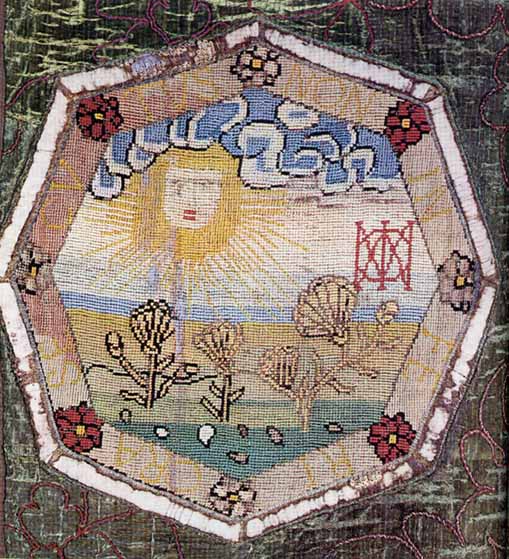
Dream Theater wordmark and "Majesty" symbol
Despite the band being forced to change their name, Dream Theater adopted a custom
logo (known as the
Majesty symbol) and
wordmark which has appeared on the vast majority of their promotional material and on the front cover of every Dream Theater studio album. The Majesty symbol is derived from
Mary, Queen of Scots' mark,
[33][34] which was re-worked by
Charlie Dominici for use on the album artwork for
When Dream and Day Unite.
[35] The symbol was reworked to contain the Greek letters
Phi (Φ),
Mu (Μ), and
Alpha (Α).
Phi Mu Alpha Sinfonia is a musical
fraternity of which John Petrucci, Mike Portnoy, and John Myung are members.
[citation needed]
[edit] Live performances
Throughout their career, Dream Theater's live shows have gradually become bigger, longer, and more diverse. The most obvious example of this is their rotational set list policy. That is, every single night of every tour has its set list devised by Portnoy using a meticulous process that ensures its uniqueness. Factors such as set lists from previous cities are taken into account to ensure that people who see Dream Theater multiple times within the same area will not see the same songs performed twice, and even the set list from the last time the band was in a particular city is taken into account for the benefit of fans who see the band on successive tours.
[36]
For this to be possible, the band prepares to play the majority of its catalogue at any performance, depending on what Portnoy decides to program for that night. This process also requires the employment of a complex lighting system to load pre-configured lighting cues based on the individual songs.
Some of Dream Theater's more notable touring partners include
Between The Buried And Me,
Deep Purple,
Emerson, Lake & Palmer,
Iron Maiden,
Joe Satriani,
King's X,
Marillion,
Megadeth,
In Flames,
Pain of Salvation,
Porcupine Tree,
Opeth,
Queensrÿche,
Riverside,
Spock's Beard,
Fear Factory,
Enchant,
Symphony X, and
Yes. In 2005, Dream Theater toured North America with the
Gigantour festival, co-headlining with Megadeth, and have played with Megadeth and Iron Maiden physically on stage.
The band's full world tours, since
Six Degrees of Inner Turbulence, have predominantly been so-called "Evening with..." tours, in which the band performs for at least three hours with an intermission and no opening act. The show that was recorded for
Live Scenes From New York was nearly four hours in length, and resulted in Portnoy almost being hospitalized after acquiring severe food poisoning from the food he ate before the show.
[37][38]
There is also a significant amount of humor, casualness, and improvisation attached to a Dream Theater concert. In the midst of "A Change of Seasons" it is quite common for themes such as those for
Major League Baseball and
The Simpsons to be quoted, and Rudess routinely modifies his solo section in the song and others, often playing the
ragtime section of "When the Water Breaks" from
Liquid Tension Experiment 2. Several songs included on
Once in a LIVETime include snippets of others' pieces, such as
Lynyrd Skynyrd's "Free Bird" and
Rimsky-Korsakov's "Flight of the Bumblebee." Other quotations include "Mary Had a Little Lamb" during "Endless Sacrifice" on the Gigantour, a calliope-inspired break between verses of "Under a Glass Moon", a quote of "
Don't Cry for Me, Argentina"'s main melody played by Petrucci while performing the intro solo of "Through Her Eyes" in
Buenos Aires, the Turkish March at a concert in
Istanbul, and the opening riff of
Rush's "
A Passage to Bangkok" at a show in
Bangkok,
Thailand. On the most recent "20th Anniversary World Tour" Rudess has even thrown in a short "Twinkle, Twinkle, Little Star" theme in a break during "Endless Sacrifice", and during a concert in Israel he started a spontaneous "Hava-Nagilla" later accompanied by the rest of the band.
Occasionally, a member of the audience is picked at random to perform on stage, an example of which can be seen during Portnoy's drum solo on the
Live at Budokan DVD. There have also been many impromptu renditions of "Happy Birthday" when a member of the band or crew has a birthday corresponding to a tour date, which normally results in a birthday cake being thrown at the subject.
Perhaps the best example of Dream Theater's unpredictable concert structure is that during Derek Sherinian's time with the band. At selected shows the band members all
swapped instruments and performed an encore as the fictitious band dubbed
Nightmare Cinema. They usually performed a cover of
Deep Purple's "Perfect Strangers", and, on one occasion,
Ozzy Osbourne's "Suicide Solution". At some shows, Sherinian, Petrucci and Portnoy would take the stage together under the name "Nicky Lemons and the Migraine Brothers". Sherinian, wearing a feather boa and novelty sunglasses, would perform a pop-punk song entitled "I Don't Like You" with Petrucci and Portnoy backing. In Chaos in Motion tour, in several concerts before "Trial of Tears", Portnoy and Petrucci would change positions and play
Van Halen's "
Eruption".
Dream Theater's largest audience as a headlining act was 20,000 in
Santiago, Chile on December 6, 2005.
[39] This was during their first tour of
South American countries other than Brazil (which they had visited in 1997 and 1998). The show was released on DVD through Portnoy's YtseJam Records.
In the
Score and
Chaos in Motion DVDs, an animation has accompanied certain parts of the songs, showing the band playing along to the music as cartoon characters. On the Score DVD, during the song
Octavarium, the band is seen performing in an octagonal shaped maze. As the animation continues Jordan Rudess spontaneously turns into
Santa Claus and John Petrucci catches fire.
[40] In "
The Dark Eternal Night" from the Chaos in Motion DVD, the band battles against a monster by shooting fireballs from guitars, throwing drum sticks, and screaming.
[41]
In 2007, after their show in Salt Lake City on July 30, Governor
Jon Huntsman, Jr. signed a proclamation officially marking July 30, 2007 as "DREAM THEATER DAY" in the state of Utah.
In 2008 Dream Theater started the "Progressive Nation '08" tour, along with
Opeth,
Between the Buried and Me, and
3. The tour is the brainchild of Mike Portnoy, who stated, "I've been wanting to assemble a package tour like this for many years now. With all of the festivals and package tours that go through America, I've been talking with our manager and agent for over 10 years now about doing something that focuses on the more progressive, musician-oriented side of hard rock and metal. I decided it was time to stop talking the talk, lace up and finally walk the walk."
[42]
On February 13, 2009, Dream Theater announced the official line up for their Progressive Nation 2009 tour. The tour was originally set to feature bands including Swedish bands
Beardfish and
Pain of Salvation, as well as
Zappa plays Zappa. On June 22, 2009, Mike Portnoy announced that Pain of Salvation and Beardfish would not be touring the North American leg of the Progressive Nation 2009 tour because of record label complications. In the same announcement, Portnoy stated that the bands
Scale the Summit and
Bigelf would replace Pain of Salvation and Beardfish on the tour.
[43] This lineup change has put
Bigelf on both the North American and European legs of the Progressive Nation 2009 tour. The tour's North American leg ran throughout July and August 2009. On March 26, 2009 it was announced that Dream Theater would take the Progressive Nation tour to Europe for the first time alongside
Opeth,
Bigelf and
Unexpect. The tour ran throughout September and October 2009.
[44]
Dream Theater will be the opening band for Iron Maiden starting June 2010 for their tour, including
Madison Square Garden as one of the many venues.
[edit] Bootleg culture
Mike Portnoy started an official
bootlegs series in response to Dream Theater fans' affinity for live versions of their concerts. Dream Theater is one of the most actively
bootlegged bands in the progressive metal genre
[dubious – discuss]. Since their very first shows in New York as Majesty, fans have recorded almost every single show that Dream Theater have played (occasionally there are three or four versions of a single concert), and some very elaborate and professional recordings have been released.
However, not every member in the band condones the release of Dream Theater bootlegs. Portnoy is the most pro-bootlegging member, since he was an avid collector of many bootlegs in his younger days and keeps his own personal archive of Dream Theater material in his basement. Petrucci and LaBrie have voiced opposition to people recording their concerts. Petrucci takes issue with bootleggers because he prefers audience members to concentrate on the musicians on stage, and not the level adjustments on their recording device. LaBrie, on the other hand, argues that bootlegging takes ownership and control over Dream Theater's performances away from the band themselves and into the hands of the public. Myung has expressed mild opposition to bootlegging, but in some interviews has mentioned that he does not particularly take great issue with it.
Dream Theater have released a series of official bootlegs, demos and other rarities through YtseJam Records, headed by Portnoy.
[45] They include demos the band put out before official albums, as well as many live shows, including shows where the band has covered a particular album. Albums covered include
The Dark Side of the Moon,
Made in Japan,
Master of Puppets, and
Number of the Beast.
[edit] Cover songs
Dream Theater has been known for
covering other artists' work throughout their career. They took this practice to a new level during the promotional tour for
Six Degrees of Inner Turbulence. At three special gigs, one each in
Barcelona,
Chicago and New York City, they covered
Metallica's
Master of Puppets album in its entirety after a full set of Dream Theater material. This came as a surprise to fans, as there was no sign that this was to occur, other than it being announced that the gigs involved, which were on the second night of a two-night stand in each city, would be "extra special". This tradition can most likely be traced back to one of Mike Portnoy's favorite bands,
Phish, who began a series of performing "
musical costumes" of entire albums from other artists each Halloween beginning in 1994. Portnoy devised this "album cover" as the first in a series of gigs to be played as tributes to bands that had been influential in the formation and development of Dream Theater. The covers set divided many fans who attended the shows, with some people saying that they went to a Dream Theater concert to see original music and not another artist's work. Others, however, said that it was a bonus and not a replacement for a normal Dream Theater concert, since an ordinary gig had been played the night before.
On the next leg of the tour they covered
Iron Maiden's
The Number of the Beast and received a similar reaction to
Master of Puppets, although it was already known that a cover was to be performed that night because the tour itinerary included two successive gigs in a single city. On October 11, 2005, Dream Theater covered
Pink Floyd's
The Dark Side of the Moon. Dream Theater's official webpage stated that the second sets of the second nights in Amsterdam, London, Buenos Aires, São Paulo and Tokyo (October 11, October 25, December 4, December 11 and January 13 respectively), and also the second set of the January 15 show in Osaka, would be a classic album covered in its entirety.
The Dark Side of the Moon was played again on October 25 in London. However, in Buenos Aires (December 4) and São Paulo (December 11) the 'classic album' played was Dream Theater's own
Metropolis Pt. 2: Scenes from a Memory, to make up for not having visited Argentina and Brazil in their
Metropolis 2000 tour. On January 13, 2006 (Tokyo) and on the 15th (Osaka), Dream Theater covered
Deep Purple's live album
Made in Japan. Portnoy says that he has one more cover show planned, but refuses to reveal when it will occur, or what album will be covered.
[46]
During Gigantour 2005, Dream Theater did a cover of
Pantera's "
Cemetery Gates" as a tribute to
"Dimebag" Darrel Lance Abbott. As an added bonus, they had
Burton C. Bell of
Fear Factory, and
Russell Allen of
Symphony X do guest vocals and
Dave Mustaine of
Megadeth, do the main solo for the song.
In March 2006, Dream Theater played the rare Rush song "Jacob's Ladder" at a show in Toronto. John Petrucci said a few days later in Asbury Park, New Jersey, prior to the night's show, that "Rush wouldn't play it, so we thought we'd play it for them."
In addition, Dream Theater released several live cover songs on their EP
A Change of Seasons, including songs from
Elton John,
Deep Purple,
Led Zeppelin,
Queen,
Pink Floyd,
Genesis,
Journey,
Kansas, and
Dixie Dregs.
In 2008, they recorded a version of
Iron Maiden's "
To Tame a Land" for a
Kerrang magazine compilation entitled
Maiden Heaven[47]. This song was later included on the special edition of
Black Clouds and Silver Linings.
Dream Theater also recorded a number of cover songs for their 2009 album
Black Clouds & Silver Linings. The songs came as a bonus disc in the special editions version of the album.
Dream Theater played "
Hava Nagila", the traditional
Jewish song, during "
Metropolis Pt. 1: The Miracle and the Sleeper" at a sold-out concert in
Tel Aviv,
Israel on June 16, 2009
.[48]
On August 14, 2009 during a Toronto show, Dream Theater played the Rush song "
The Camera Eye", which was originally released on Rush's
Moving Pictures album.
Dream Theater also performed a cover of "Comfortably Numb" by
Pink Floyd accompanied by
Queensrÿche on one tour (date/location to be verified).
[edit] Discography
In addition to the above official albums, the members of Dream Theater, past and present, have contributed to hundreds of bootleg albums, both official and unofficial, side projects, collaborations with other artists, and guest appearances.
[49]
[edit] Band members
- Current members
|
- Former members
|
[edit] Awards and certificates
- RIAA gold and platinum certification[50]
- Images and Words (Gold) - February 2, 1995
- Metropolis 2000: Live Scenes From New York (Gold) - November 8, 2002
- Live at Budokan (DVD) (Platinum) - January 26, 2005
- Live in Tokyo/5 Years in a Livetime (Platinum) - March 22, 2006
- Score (DVD) (Platinum) - October 11, 2006
- Keyboard Magazine
Jordan Rudess was awarded the following Keyboard Magazine
Reader's Poll award':
- Best New Talent (1994) [51]
- Burrn magazine's best keyboards player of the year (2007)
- Modern Drummer
Mike Portnoy won the following
Modern Drummer magazine Reader's Poll awards:
- Best Up & Coming Talent (1994)
- Best Progressive Rock Drummer (1995–2006)
- Best Recorded Performance (1995 for Awake, 1996 for A Change of Seasons, 1998 for Falling Into Infinity, 2000 for Metropolis, Pt. 2: Scenes From a Memory, 2002 for Six Degrees of Inner Turbulence, and 2007 for Score)
- Best Clinician (2000, 2002)
- Best Educational Video/DVD (2000, 2002)
- Hall of Fame Inductee (2004)
- Guitar World
The album
Metropolis Pt. 2: Scenes from a Memory was ranked #95 on the magazine's list of the
100 Greatest Guitar Albums of All Time.
[52]
- Total Guitar Paul Gillard
John Petrucci won
Guitarist of the year award (2007).
- Other recognitions
- At Dream Theater's Salt Lake City show, Governor Jon Huntsman, Jr. signed a proclamation making July 30, 2007 "Dream Theater Day".
- In December 2007, Dream Theater was chosen as Xbox Live's artist of the month.
- Dream Theater's music video "Constant Motion" was voted second in the Headbanger's Ball 2007 competition.
- Dream Theater's music video "Forsaken" was voted fifth in the Headbanger's Ball 2008 competition.
- Dream Theater's song "Panic Attack" off of their album Octavarium is featured in the video game Rock Band 2.
- The song "Pull Me Under" from the album Images and Words is also featured on both Guitar Hero: World Tour, and Rock Revolution, with the latter being a cover.[citation needed]
- Since August 12, 2008 (Xbox 360) and August 14, 2008 (PS3), Dream Theater's song "Constant Motion" has been available for download for Rock Band. For the first month, it was available for a promotional price equivalent to $0.99 USD, but later reverted to a normal $1.99 cost for Rock Band downloadable content.
- Dream Theater played twice on Xbox 360s Game With Fame event. They played Halo 3 in December 2007[53] and Call of Duty: World at War in June 2009.[54]
[edit] References
- ^ Allmusic
- ^ a b c d Billboard Chart history for Dream Theater can be seen at Billboard.com.
- ^ "February 9, 2007". Nielsen Soundscan News. 2007. http://www.marketingtomenconference.com/marketingtomen/bb_article_display.jsp?vnu_content_id=1003544204. Retrieved 2007-02-11.
- ^ "Dream Theater causing chaos with new album". billboard. 2007. http://www.billboard.com/news/dream-theater-causing-chaos-with-new-album-1003604046.story#/news/dream-theater-causing-chaos-with-new-album-1003604046.story. Retrieved 2010-05-23.
- ^ a b c d e This was referenced in the documentary "The Score so Far", on the second disc of the Score DVD.
- ^ Portnoy, Mike (2003). "The Majesty Demos 1985-1986" [CD Liner Notes]. New York: Ytsejam Records.
- ^ "The Dream Theater FAQ - Graphic Version". Gabbo.net. http://www.gabbo.net/dt/faq/. Retrieved 2009-01-02.
- ^ a b Portnoy, Mike (2004). And Nathan Edmonds help produce "When Dream and Day Unite Demos" 1987-1989 [CD Liner Notes]. New York: YtseJam Records.
- ^ Dominici, Charlie. When Dream And Day Unite liner notes (2004 re-release).
- ^ a b c d Please see MikePortnoy.com tourography for more information on this tourdate.
- ^ Portnoy's tourography: June 9, 1990 tour date
- ^ EastWest Records Press Release.
- ^ Nine Christmas CDs were released through Dream Theater's fan club before it was closed down in 2005. See DTIFC on Dream Theater.net.
- ^ LaBrie, James. (Summer '97) Images & Words No. 14, pg. 5
- ^ Falling Into Infinity Demos
- ^ Portnoy, Mike (1998). "Liquid Tension Experiment" [CD Liner Notes]. New York: Magna Carta Records.
- ^ "Mike Portnoy FAQ". http://www.mikeportnoy.com/aboutmike/faq/answers/12.aspx#213.
- ^ DreamTheater.net reported that Six Degrees of Inner Turbulence had reached #1 on the Billboard Internet Charts.
- ^ Mike Portnoy (2007) "In Constant Motion" Instructional DVD, Train of Thought album analysis.
- ^ http://digitalprosound.digitalmedianet.com/articles/viewarticle.jsp?id=45690
- ^ "Lifting Shadows - The Authorised Story Of Dream Theater". Dreamtheaterbook.com. http://www.dreamtheaterbook.com/. Retrieved 2009-01-02.
- ^ Gods of Metal official website
- ^ "DREAM THEATER Begins Recording New Album, Seeks New Label Home". Blabbermouth.net
- ^ "OPETH To Support DREAM THEATER In North America." [1]
- ^ [2]
- ^ Dream Theater’s Mike Portnoy Pens Tribute To Late Father
- ^ http://www.metalsetlists.com/showthread.php?t=11043
- ^ Holy Shit, Dream Theater debut's at 6 on Billboard Top 200, The Gauntlet
- ^ http://www.mikeportnoy.com/forum/m2443312.aspx
- ^ http://www.dreamtheater.net/tourdates.php#dtnzaustralia
- ^ http://www.roadrunnerrecords.com/news/Dream-Theater-To-Tour-With-Iron-Maiden-This-Summer-21029.aspx
- ^ http://beyondthedarkhorizon.com/main/?p=4559
- ^ The mark used by Mary, Queen of Scots, is available on DreamTheater.net.
- ^ An embroidery showing the Mary, Queen of Scots, symbol in use
- ^ Dixon, Brad et al. "What is the 'symbol' DT use?".
- ^ Campbell, Courtney. "Mike Portnoy - Dream Theater". Earplugs Required.
- ^ See the Metropolis 2000: Scenes From New York DVD
- ^ Hansen, Scott & Portnoy, Mike. "What’s this I hear about Mike being really sick after the Roseland (DVD) show? What happened?". MP FAQ.
- ^ Voices UK: Dream Theater Fan Club "Dream Theater News: Record crowd"
- ^ Octavarium animation
- ^ NADS Animation By: Mika Tyyska
- ^ "Progressive Nation 2008 - Press Release". dreamtheater.net (Dream Theater). 2007-11-05. http://www.dreamtheater.net/news_dreamtheater.php#prognation. Retrieved 2008-05-11.
- ^ Progressive Nation 2009 North American Tour - Lineup Change
- ^ Progressive Nation Tour Dates
- ^ "YtseJam Records - The Official Dream Theater Bootlegs". Ytsejamrecords.com. http://www.ytsejamrecords.com. Retrieved 2009-01-02.
- ^ Hansen, Scott & Portnoy, Mike. "What are all the aspects involved in covering an entire album by another band? What does Mike take into consideration when picking an album?". MP FAQ.
- ^ Maiden Heaven track listing revealed!
- ^ http://whiplash.net/materias/news_874/091017-dreamtheater.html
- ^ http://www.dreamtheaterforums.org/discography/page4.html
- ^ riaa.com
- ^ Jordan Rudess biography
- ^ http://rateyourmusic.com/list/Boggs1027/guitar_worlds_100_greatest_guitar_albums_of_all_time
- ^ http://www.xbox.com/en-US/community/calendar/gamewithfame/2007/1218-dreamtheater-recap.htm
- ^ http://www.xbox.com/en-US/community/calendar/gamewithfame/2009/0620-dreamtheatre.htm
[edit] Further reading
- Bredius, Mark. Dream Theater - The Official Site. (Retrieved February-April, 2005.)
- Dixon, Brad et al. Official Dream Theater FAQ. (Retrieved February-April, 2005, moved c. 2007.)
- Hansen, Scott & Portnoy, Mike. Dream Theater Tourography. (Retrieved February-April, 2005.)
- King, Brian. (2003). "JaM Progductions! Interview with John Petrucci and Mike Portnoy". Theater of Dreams 29, pp. 14–20.
- Hansen, Scott. (2003). "James LaBrie: As this man thinks". Theater of Dreams 27/28, pp. 26–30.
- Hale, Mark (1993). "1731 Majesty". Headbangers (First edition, second printing ed.). Ann Arbor, Michigan: Popular Culture, Ink. ISBN 1-56075-029-4.
[edit] External links
 Lagu pertama yang saya denger dari The Gazette (yang dulu namanya Gazette ガゼット saja) adalah Zetsu, dimana dalam PV, Uruha(gt) dengan kostum ’sexy’ bermain gitar dengan melodi yang menurut saya ‘indah’.Dari situ saya mulai berminat melihat PV-PVnya yang lain. Cukup kaget juga dengan perkembangan The Gazette yang sekarang. Denger-denger Ruki(vo) sudah berhenti merokok, pantas saja vocalnya kian berkembang, lebih konstan, lebih berkarakter.The Gazette saya rasa tidak terlalu lama ber-indie. Meski sedikit shock dengan album Stacked Rubbish(2007), namun setelah single Guren saya dengar, saya rasa The Gazette sudah menemukan jati diri mereka sebagai band mayor.Vocal Ruki yang ga ada matinya, permainan gitar Aoi yang sugoi, permainan gitar Uruha yang melodius, bassnya Reita yang mendegum, serta drummingnya Kai yang fast, konstan, dan energik merupakan perpaduan yang pas buat band satu ini. I hope The Gazette will not broke. Gaze Rock is not Dead!
 Alasannya sich cuma karna lama-lama lagunya terasa membosankan. Walaupun begitu, Laruku masih favorit saya.Wah kalau Laruku bubar sudah pasti jadi band legendaris yang bertahan lebih dari 10 tahun, kejadian yang langka banget. Tapi mungkin bagi kebanyakan fans berharap Laruku tidak pernah bubar dan terus nge-band sampai tua, tapi ga bisa gitu juga ya!?^^Manusia memang terbatas tapi karyanya kan pasti abadi. The great band that I had seen. Laruku ini udah langganan manggung di Tokyo Dome (cuma artis-artis beken yang bisa manggung di sini), bahkan bisa bolak balik Tokyo Dome kalo mau (berarti tukang bersih-bersih di Tokyo Dome hebat juga ya bisa keluar-masuk Tokyo Dome^^).Sedikit kecewa dengan album kiss, tapi terobati dengan lagu Black Rose, Link, dan Day break’s bell. Vocal Hyde juga ga ada matinya. Sukses terus deh buat Laruku!


 film THE KARATE KID bercerita Dre Parker (Jaden Smith) tak pernah ingin meninggalkan teman-temannya namun karena ibunya harus pindah ke Beijing maka tak ada pilihan buat Dre selain pasrah. Sebagai pendatang baru jelas masalah yang dihadapi Dre tidaklah mudah. Selain harus beradaptasi dengan lingkungan baru Dre juga masih harus berhadapan dengan para berandal di kota yang baru ini.
 Jakarta -SURYA – Siluet putih tampak berputar di langit dan turun di atas Ka’bah. Video ‘malaikat’ turun di atas Ka’bah itu saat ini jadi pembicaraan di Facebook dan populer di YouTube.


 TAU KAN MAKSUDNYA.......'''